The Price of Being Fair
2025-02-18
7 mins
Notes
- I purchased this book after seeing it in a NTUC FairPrice store when I visited Singapore in 2023.
- Many Singaporeans have told me that everyone refers to NTUC FairPrice simply as "NTUC".
- Events in the summary are presented as they were from the book with no fact-checking.
Summary
-
Chapter 1: NTUC Fairprice is created
- NTUC (National Trades Union Congress) is founded in 1961 and is the only labor union congress in Singapore. It is similar in purpose to AFL-CIO in the United States.
- In the 70s, Singapore experiences heavy inflation. The book never explicitly explains why, but the 1973 oil crisis likely plays a part.
- In response to high prices and profiteering during this time, the NTUC launches its first cooperative grocery store in Toa Payoh, called "NTUC Welcome".

"打倒奸商 稳定物价 DOWN WITH PROFITEERING"
(ELIMINATE PROFITEERING, STABILIZE PRICES)](https://joseph-x-li.github.io/processed_images/profit.a5548c80ca473251.jpg)
PAP Anti-profiteering float in 1972 parade
"打倒奸商 稳定物价 DOWN WITH PROFITEERING"
(ELIMINATE PROFITEERING, STABILIZE PRICES) - PAP MP Phey Yew Kok launches two other cooperative grocery stores under SILO union and PIEU union. He is charged with misappropriation of funds and flees the country, leaving these two stores leaderless.
- SILO and PIEU merge in 1981 to form SEC.
- SEC merges into NTUC Welcome in 1983 to form NTUC FairPrice.
-
Chapter 2: FairPrice housebrand
- The first product FairPrice sells under no brand is rice.
- NTUC formally launches its housebrand "FairPrice" in 1985.
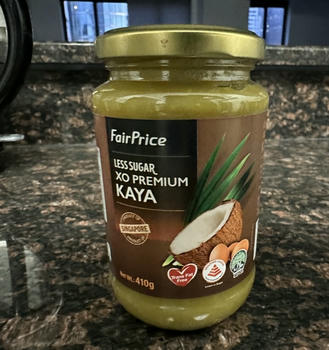
Jar of FairPrice housebrand kaya that was gifted to me
-
Chapter 3: Overseas expansion
- FairPrice attempts to expand into China, forming a joint venture "Nextmall" in 2003 with mainland partners.
- The joint venture over-expands in China, leading to massive losses as they open unprofitable stores.
- FairPrice fails to expand in Malaysia and Myanmar too. They find success in Ho Chi Minh City, Vietnam with four "Co.opXtra" hypermarts.
-
Chapter 4: Fresh Foods
- FairPrice Launches "Pasar", a brand for fresh foods.
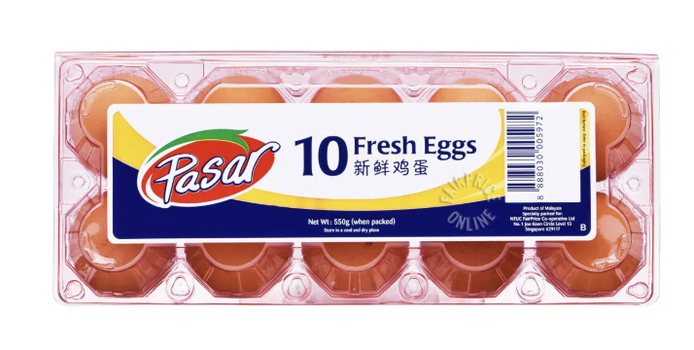
FairPrice Pasar brand eggs
- FairPrice Launches "Pasar", a brand for fresh foods.
-
Chapter 5: Convenience stores
- FairPrice decides to open convenience stores in the mid 1990s, competing with 7-Eleven which had 100 stores in Singapore at that time.
- They open 13 stores far away from existing 7-Eleven locations before exiting stealth in the year 2000.
- Growth is tough because 7-Eleven has already taken the good locations. Additionally, sales of hot food items must compete with hawker centers. This crushes sales.
- FairPrice is given a great opportunity to expand when ExxonMobil decides to offload operations of gas-station conveninece stores to someone else and picks FairPrice.
- In 2005, FairPrice takes over all 77 Esso gas station convenience stores. Esso is the brand name of ExxonMobil's gasoline.
- FairPrice operates two convenicnce store brands: Cheers and FairPrice Xpress. Cheers is strictly a convenience store. Xpress consists of a mini grocery store in addition to the convenience store.

Esso gas station with a FairPrice Xpress in Ang Mo Kio
-
Chapter 6: Destroying French retailer Carrefour
- In 1997, multinational French retailer Carrefour decides to open hypermarts in Singapore.
- Hypermarts carry large consumer goods in addition to groceries. They are close in style to Target, while FairPrice is more similar to Safeway or Publix.
- Carrefour opens it first hypermart in a shopping mall called "Suntec City", located near the central business district of Singapore.
- In response, FairPrice opens a store in a nearby shopping mall called "Plaza Singapura".
- Carrefour attempts to open its second hypermart in Hougang, a region in Singapore's northeast. A developer is opening a new mall there called "Hougang 1" and is looking for a grocery store to anchor the mall.
- To prevent Carrefour from getting a solid foothold in Singapore, FairPrice tells the developer it will match Carrefour's bid.
- The deal with Carrefour falls through, leaving FairPrice with the lease.
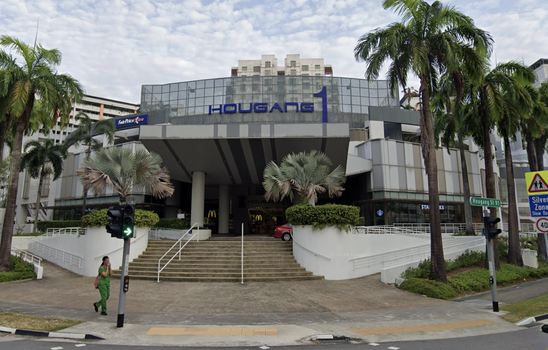
The Hougang 1 mall with a FairPrice Xtra sign
- In 2003, Carrefour finally opens its second store in Plaza Singapura, the same mall where FairPrice opened its own store to compete with Carrefour's Suntec City location.
- Carrefour's locations are located within the ERP tolling zone, which means most store traffic occurs on weekends when the ERP toll is not enforced. To choke off Carrefour's sales on these crucial weekends, FairPrice runs special discounts on all stores during weekends.
- Carrefour pulls out of Singapore in 2012, selling its locations to FairPrice.
-
Chapter 7: Defending against Singaporean retailer Sheng Siong
- Remember the mini scandal in Chapter 1 where Phey Yew Kok launched his own illicit line of stores? Some of those stores were called Savewell.
- When Phey Yew Kok flees Singapore, he sells the Ang Mo Kio Savewell outlet to the man running the pork counter at that location.
- That man is called Lim Hock Chee. He and his brothers rebrand Savewell to Sheng Siong. It is known for being very cheap and having wet-markets.
- Sheng Siong builds a reputation for being THE cheapest retailer -- even cheaper than FairPrice.
- FairPrice begins rolling out stores that resemble wet markets to directly compete with Sheng Siong.
- The book acknowledges that Sheng Siong has an operational edge. In 2021, they reported S$133 million net profit on S$1.4 billion in revenue, yielding net profit margins close to 10%. FairPrice, by comparison, reported S$99.7 million net profit on S$4.3 billion revenue, for a net profit margin of roughly 4.3%.
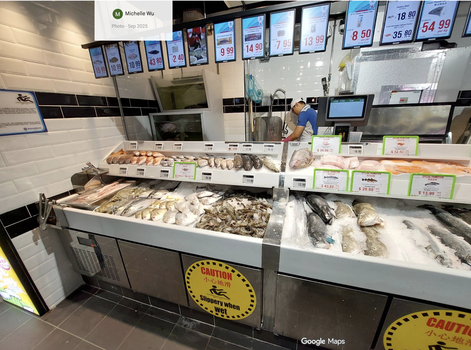
Fish market section at a Seng Siong location
-
Chapter 8: Competing with Singaporean retailer Cold Storage
- FairPrice opens a brand called "FairPrice Finest" to compete with existing Singaporean upscale supermarket comapny called "Cold Storage".
- The book does not explain in detail how Finest differentiates itself from Cold Storage, other than possibly cheaper prices.
-
Chapter 9: Even lower prices
- A consumer survey reveals FairPrice captures 40th to 80th percentile income sales well, but does poorly with lower income shoppers.
- FairPrice leadership views this as a problem because the brand was built on providing low-cost essentials.
- FairPrice introduces an EDLP scheme (Everyday Low Price) that prices 500 essential items very low.
- FairPrice observes that consumers are most sensitive to the price of eggs, rice, chicken, noodles, and toilet paper.
- Egg prices are fixed to S$6.75 to gain consumer activity.
-
Chapter 10: Politics
- FairPrice attempts three times to curb plastic bag usage. In 1974, it charged 12 cents per bag, but reversed the decision in two weeks. In 2007, it provided a 10 cent discount for people who brought their own bag. In 2019, it began charging 10/20 cents per bag.
- In 2012, FairPrice becomes the first major grocer to pull shark fin products.
- In 2015, FairPrice pulls Indonesian paper products over environment concerns related to frequent Indonesian wildfires.
-
Chapter 11: Operations during SARS-CoV-2
- To handle increased distribution requirements, some Xtra stores were converted to warehouses.
- To combat panic buying, employees maintain full shelves either through eager restocking or by filling gaps with bulky items.
- Trucks loaded with groceries drive to serve physically distant locations.
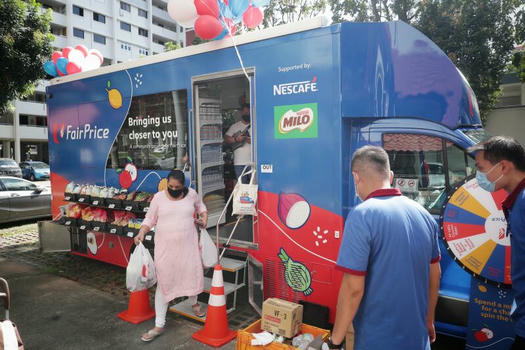
'FairPrice on Wheels' truck
-
Chapter 12: Procurement
- In 2022, Malaysia bans all chicken exports due to rising domestic chicken costs. FairPrice sources 50% of its chickens from Malaysia but is largely unaffected because they maintain a four month stock of frozen chickens.
- FairPrice operates a similar three month stockpile for rice.
- GLS (Grocery Logistics of Singapore) operates receiving, shipping, and warehouse logistics for FairPrice.
-
Chapter 13: Digital transformation
- In a joint venture with Standard Chartered Bank, FairPrice launches the digital-only Trust Bank in 2022.
- FairPrice competes with RedMart and Amazon Prime for online shopping revenue. It leverages physical stores to offer same-day delivery.
-
Chapter 14: Public listing
- Many people fought over whether FairPrice should be publicly listed.
- Those in favor argue that extra capital will help FairPrice streamline operations and provide better prices.
- Those against argue that shareholders will demand higher profits, going against FairPrice's primary mission of low prices.
- PAP and NTUC leadership generally agree that FairPrice should remain a cooperative.